THE EMPTY TOMB
The Tomb Guarded
The religious leaders of the time went to great pains to get rid of Jesus who, in their minds, threatened to undermine their authority. They were well aware of the message of Jesus and wanted to make sure that Jesus was dead and buried and a line would be drawn under the whole affair so they could move on and the Jesus movement would be forgotten. As they were still not 100% at ease they aimed to make sure that nothing could go wrong. In the Gospel of Matthew we read of the precautions they took.
The next day, that is, after the day of Preparation, the chief priests and the Pharisees gathered before Pilate and said, “Sir, we remember how that impostor said, while he was still alive, ‘After three days I will rise.’ Therefore order the tomb to be made secure until the third day, lest his disciples go and steal him away and tell the people, ‘He has risen from the dead’, and the last fraud will be worse than the first.” Pilate said to them, “You have a guard of soldiers. Go, make it as secure as you can.” So they went and made the tomb secure by sealing the stone and setting a guard. (Matthew 27: 62-66)
Nothing was left to chance. The religious leaders themselves could guarantee that nothing embarrassing could take place. The tomb was 'made secure' (mentioned twice), the stone was sealed and all was under the surveillance of 'a guard of soldiers', probably by four soldiers. The stone was sealed with the official Roman imperial seal and the penalty for breaking the seal was death. Security measures were indeed tight, to say the least. Accessing the tomb by the fearful disciples of Jesus or anyone else was made impossible.
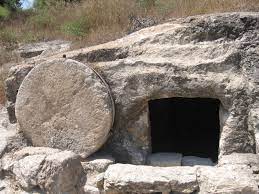
The Empty Tomb
The Tomb is empty, the prophecies and predictions have been fulfilled; Jesus has risen from the dead as he foretold during his earthly life. He is alive and the religious leaders still had to contend with the problem of Jesus. There is an attempt at a cover-up and bribery. The plan of God was fulfilled: Jesus was put to death, rose from the dead and on the third day there was no body in the tomb of Jesus, he has risen in accordance with the Scriptures. Death and the odour of death had left that tomb, death had been defeated.
After the resurrection and when the tomb was discovered to be empty and the body absent, we read the following describing the scheming state of mind of the priests:
While they were going, behold, some of the guard went into the city and told the chief priests all that had taken place. And when they had assembled with the elders and taken counsel, they gave a sufficient sum of money to the soldiers and said, “Tell people, ‘His disciples came by night and stole him away while we were asleep.’ And if this comes to the governor's ears, we will satisfy him and keep you out of trouble.” So they took the money and did as they were directed. And this story has been spread among the Jews to this day. (Matthew 28: 11-15)
The chief priests were panicking, they had to come face to face with their worst fears, “Sir, we remember how that impostor said, while he was still alive, ‘After three days I will rise.’" They had to think up something quickly, "His disciples came by night and stole him away", all backed up by hush money, "they gave a sufficient sum of money to the soldiers". The story stuck. Let us examine this explanation.
Did the Disciples Steal the Body?
It was impossible to take the body away. First of all the rock was huge and would have required the strength of several men to move and it was made precisely to prevent the removal of the body, "give the order to have the sepulchre kept secure until the third day" (Matthew 27: 64). It was especially guarded because lack of attention and precision would have been socially, politically and religiously disastrous both for the Jews and for the Romans. The stone was sealed and a guard was placed outside and Pilate said to the Jews, "You may have your guard; go and make all as secure as you know how" (Matthew 27: 65). Besides to do this while the guards were sleeping ("while we were asleep") is beyond belief. The noise would surely have woken them up.
Besides, after the death of Christ the disciples did not have the courage or the state of mind necessary to steal the body of Jesus. The psychological state of the friends of Jesus was certainly not conducive to carrying out the task of stealing the body. They were lying low and not to be seen in public.
Peter, for example, was a person full of self-confidence, he placed great trust in his own strength and ability; he was a man that was sure of himself but did not want to risk being associated with Jesus after his arrest. Here's the reaction of Peter when he was recognized as a friend and follower of Jesus:
Meanwhile Peter was sitting outside in the courtyard, and a servant-girl came up to him saying, 'You, too, were with Jesus the Galilean.' But he denied it in front of them all. 'I do not know what you are talking about,' he said. When he went out to the gateway another servant-girl saw him and said to the people there, 'This man was with Jesus the Nazarene.' And again, with an oath, he denied it, 'I do not know the man. ' A little later the bystanders came up and said to Peter, 'You are certainly one of them too! Why, your accent gives you away.' Then he started cursing and swearing, 'I do not know the man.' And at once the cock crowed, and Peter remembered what Jesus had said, 'Before the cock crows you will have disowned me three times.' And he went outside and wept bitterly. (Matthew 26: 69-75).
We see the image of a man completely defeated and having to come to terms with his weakness and incoherence. He now felt that those years spent with Jesus were a complete failure and he did not want to risk his life for a lost cause. The day of the resurrection, which was a Sunday, the friends and followers of Jesus were gathered in a room because they were afraid of their enemies:
In the evening of that same day, the first day of the week, the doors were closed in the room where the disciples were, for fear of the Jews. Jesus came and stood among them. He said to them, 'Peace be with you' (John 20: 19).
They had hidden in a room behind locked doors for fear of the Jews; they were in no state to organise the theft of a dead body. Furthermore, of what use would a dead body have been to them? A dead body could not turn these fearful men into the audacious and fearless men they became after their encounter with the risen Jesus. Besides, if they had stolen the body they would certainly not have suffered persecution and death for preaching Jesus' message of salvation. Nobody suffers and dies for what is known to be a lie!
In any case where would they have hidden a body? They already had to bury Jesus in a borrowed grave: that of Joseph of Arimathea (Matthew 27: 57-60). Another important detail is that no one would have stolen the body and left the shroud and linen cloths in which it was wrapped! Not only would they have had to have the nerve and the time to unwrap the body, but also fold the shroud that covered the head and put everything neatly in a corner apart! (John 20: 6, 7).
The shroud and the linen bandages were still there for the simple reason that they did not participate in the resurrection of the body of Jesus! It was not just the absence of the body that pointed to the resurrection but also the presence of everything in which that body was wrapped. Whoever reads the report of this discovery easily notes the sense of joyful surprise of the witnesses (Matthew 28: 1-15, Mark 16: 1-8), Luke 24: 1-12, John 20: 1-10).
It would have been meaningless and impossible to steal the body. The only other alternative is that Jesus rose from the dead as predicted centuries earlier and as he himself also predicted during his lifetime. The chief priests, when they invented the explanation of the stolen body, did so because they linked it to Jesus' predictions that he would rise again (Matthew 27:63, 64). It was the only way they could deny the deny the resurrections. Judaism still adheres to that explanation.
------------------
Next: The Resurrection of Jesus Part 3, Post-resurrection Appearances of Jesus
Introduction to the Christian Faith - Index
© R W
bsgbiblestudyguide@gmail.com